Written by: Diego Jarak
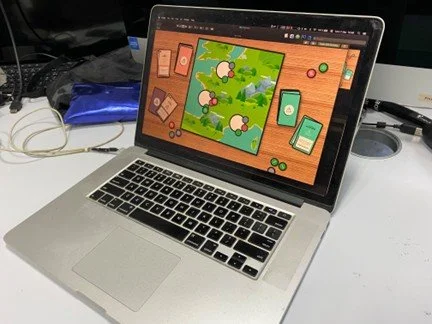
Abstract: This article reports a situated case of research-creation (RC) in French higher education through the OCAM project, which designed and iterated a serious game to hybridize teaching and learning. Combining creative ethnography, artifact analysis and semi-structured interviews, we examine how RC enables students and staff to experiment, recombine and readjust pedagogical practices under concrete institutional constraints. We describe the game’s core mechanics and the governance of its iterative process (from analog board game to pixel-art prototype), and we present qualitative evidence of individual and collective benefits, alongside tensions with assessment regimes, timetables and quality-assurance procedures. We discuss RC as a form of micro-innovation in process and governance, and propose actionable recommendations for program directors, pedagogy units and university services. Our contribution is twofold: (1) a theoretically grounded and empirically documented account of RC as hybrid pedagogy via a serious game; (2) a process-based evaluation perspective that complements competency-based assessment. We also specify where governance frictions emerged in practice (pedagogy-unit timelines, timetable lock-ins, quality-assurance procedures) and how these shaped design decisions, to avoid a merely normative stance and keep claims auditable against process evidence.
Keywords: research-creation; serious game; hybrid pedagogy; creative ethnography; anarchive; governance; process-based evaluation; French university; digital culture.